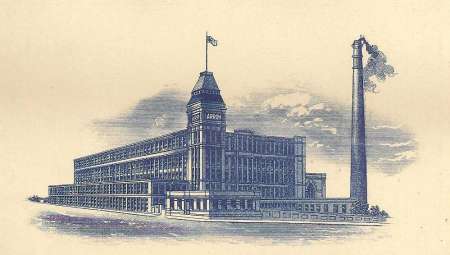
Arrow Mill, Castleton
Originally containing five acres of floor space, Arrow Mill was a fine example of the speed of mill building at the time. The contract to build was signed in late 1906, the first brick was laid in January 1907, the engine first ran under steam in February 1908, and the first cotton was spun in this large mill fifteen months after the first brick was laid.
A large number of people interested in the cotton trade attended the ceremony of naming the steam engines at the Arrow Mill, Castleton, which was performed on Saturday afternoon by Mrs. Waller of Wilpshire, Blackburn, wife of Mr W. H. Waller, the chairman of directors. Mr. Smithies, one of the directors, observed that in the building and equipment of the mill the desire of the directors had been to get the buildings and machinery of the best possible character so that they would be able to confidently meet the competition that they would have to encounter in the market. Owing to the exceptionally wet weather last year the mill had not been built in exactly record time, but taking everything into account the contractors had done very well. The directors held their first meeting on 17 October 1906. and let the building contract on November 11th of the same year. Mr. John Taylor laid the first brick on 9 January 1907; the engine was started on 8 February 1908 and the first cop spun on 10 March. When full the mill would hold about 115,000 mule spindles to spin from 60s to 80s counts. The shares were well applied for, and all were allotted very early in the history of the company. They had been very well supported in the way of loan money, and everything about the mill betokened that they would show satisfactory results to the shareholders.
Mr. Norris, representing Mr. Sydney Stott, the architect, for whose unavoidable absence he apologised, briefly described the mill. The first essential fora mill of that kind was that it should have good ground as a foundation; the second was that it should have water near it: and the third essential was that it should have good builders, and that their work should be well and faithfully done. The Arrow mill had all these essentials. It was a fireproof structure and contained about five acres of floor space.On behalf of Mr. Stott he had pleasure in expressing satisfaction with the way the various building contractors had done their work. Mr. Hawkins of Messrs. R. and T. Howarth, the contractors for the building, supplemented Mr. Norris’s description of the mill, stating that it was commenced in January and was roofed in by September, notwithstanding that last summer was one of the worst for bad weather that he could remember.
THE ENGINES DESCRIBED - Mr. Hawkins, the representative of Messrs. J. and W. McNaught. gave a description of the engines. They ware of the kind generally termed the inserted triple expansion type, and were fitted with three cylinders of 25, 38 and 60 inches diameter, each with a stroke of four feet. The number of revolutions per minute was 75, and they were proportioned for a daily working steam pressure of 180 lbs to the square inch. They were designed for an anticipated normal load of 1,700 i.h.p. As to the rope drum, this was 22ft. in diameter, grooved for 40 ropes of 1 inch diameter. and the wheel complete weighed about 47 tons. The method of condensing was somewhat different from the system usually employed in this district. It consisted of a surface condenser, a double-acting circulating pump, a single acting patent vertical air pump. and a large oil separator. The accessories supplied with the engine were very complex and included McNaught’s patent barring engine, Tate’s patent electric stop motion, speed and pressure regulator metallic packings, steam and vacuum gauges a complete installation of lubricators and, in fact, everything necessary for the full equipment of a high-class modern steam engine. The engine had been running for two months and had not given one minute’s trouble since it began to work.