Casino, Pleasure Beach, South Shore, Blackpool
Reference Twentieth Century Society
Joseph Emberton’s work for the Pleasure Beach culminated in a replacement for the Casino building of 1913. Despite the name, neither this building nor its replacement were ever intended or used for gambling. Emberton designed it from 1937 with Halstead Best of Blackpool as associate architect.
A casino on the pleasure beach, built on the site of its predecessor. A long-term reorganization scheme has been prepared for the whole pleasure beach by Mr. Emberton and is being carried out in stages. The casino contains bars, games rooms, a restaurant, cafeteria, banqueting hall and roof gardens in its public section; and administrative offices on the first floor. The flat roof overlooks the sea and pleasure beach and is to be equipped for sunbathing. The hoods over the windows are fitted with floodlights, and the frame next the tower is to be used for signs.
The circulation has been carefully studied to keep the various types of patrons separate. Patrons of the bar and billiards rooms enter through a separate door and aroid the main restaurant traffic; the cafeteria has entrances at both ends and its own lavatories. Patrons of the first-class restaurant and cocktail bar also hare a separate entrance. Kitchens and services are in the centre of the building. Kitchens are duplicated on each floor but are served from the same stores and offices by a battery of lifts. Administrative offices have a separate entrance and overlook the pleasure beach, which the management also controls.
R.C. framed on an R.C. raft with slab floors. The building is faced with patent vibrated concrete slabs, the outa surface being slightly polished. Cornices and window frames are the same dense vibrated concrete. In most cases glazing is bedded in mastic direct in the concrete.
The bar and billiards room has been planned on two levels so that patrons can watch the games. joinery is of walnut and lighting is concealed in the billiards room dado. The radiating beams in the banqueting hall carry tracks from which partitions tan be hung to subdivide the hall. Administrative offices are double glazed between rooms and floors are of cork. Centre doors to snack bar are automatically controlled by a photo-electric ray. The doors are amour-plate glass. Metal work is grey.
The main staircase gives access to all public rooms from the pleasure beach. It is of reinforced concrete, finished in cream terrazzo, with a black non-slip strip in each step. Walls and ceiling are broken white; one handrail is ivory, the other tomato red. The general contractors were Blackpool Pleasure Beach, Limited. For sub-contractors, see page 150.
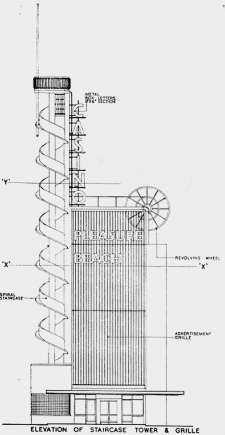
The tower, which consists of a reinforced concrete spiral staircase round a central column. and the advertisement grille beside it form the main feature of the circular Casino building. They are situated over one of the two main entrances to the building. The advertisement grille, which is to be used for advertising attractions at the Casino. consists of a reinforced concrete frame in which are fixed vertical tubular steel rods, supported at intervals On the horizontal concrete platforms. To this grille can be attached metal box lettering housing neon tube lighting. At the corner of the reinforced concrete frame, a revolving wheel is fixed constructed in metal section. Additional metal box lettering has been fixed to the side of the tower.
BLACKPOOL - The new Casino at Blackpool is a large circular, two-storied structure with a flat roof for sun-bathing and for viewing others doing the same on the pleasure beaches and I suppose even the distant sea, and there is an exciting tower with an outside corkscrew staircase. Inside there are restaurants, banqueting halls, bars and games rooms, but no mention of dancing. I am sure dancing rather than banqueting is in the spirit of the building, which is one of Joseph Emberton’s happiest efforts in making this most unattractive resort really attractive. If only the Corporation would hand the whole town over to him, and especially let him design their famous, but really rather infamous, illuminations, what a really happy place it might be instead of what it is, a piece of excellent seaside spoilt by the ugliest buildings in England, built in the hardest red brick. That masses of working people in the Midlands and North think it something else shows what harm advertising can do to the natural good taste of Englishmen. (Reilly) [Architects’ Journal 18 January 1940 page 101]