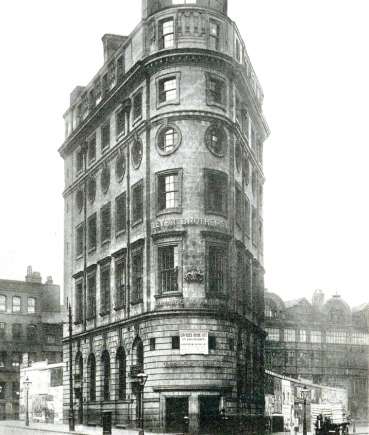
Commercial Chambers, 47 Corporation Street, Manchester
Manchester’s version of New York’s 1902, Flatiron Building, was, sited at the north end of a triangular plot opposite the Corn Exchange on the corner of Hanging Ditch and Corporation Street and backing onto an extensive cleared area suggestive of a wartime bombed site. At seven storeys it was nowhere near as impressive as the New York 22 storey version, but it was a local landmark
From the evidence of OS maps and photographs the adjoining open site seems to have been the delayed result of long-term city reconstruction plans rather than the blitz: The Goad Insurance Map of 1886 shows the area densely occupied centred on a pub, the Spread Eagle Hotel. But around 1900 – 1910 the whole area was cleared and trimmed to allow Canon Street to be extended to join Cateaton Street, providing a cross town link from west to east parallel to Market Street. The truncated site remained undeveloped until Lever built Commercial Chambers for Lever Bros. own offices at its north end in 1912, though a further slice was removed when the new street was widened, c 1930, to accommodate two tramway sidings. The new offices were proudly featured in Progress, the Lever Bros. house journal, in 1913.
However the 1919 Slater’s Manchester and Salford Directory surprisingly records Lever Bros. still being at 24 Fennel Street, facing across the street to the north frontage of the Corn Exchange, with only Planters Margarine, a Lever Bros. associated company, in Commercial Chambers itself, but the two companies were resident there together in 1923 though by the 1930s Lever Bros had moved to 81 Fountain Street, to a building now also demolished. The reason for the brief occupancy is perhaps revealed in the one letter relating to the building so far uncovered in the Unilever Archives: It is from Lever to J.L. Ferguson, a director of Lever Bros. and a nephew, dated 6 December 1919, in response to news that the rest of the triangular site was for sale: “…I am certain we shall never get a better opportunity of a fine Manchester office than this affords us and that our present investment in the office on a part of this site can only be maintained by the ownership of the whole site, and the making of the present office suitable for our needs which it has never been in the past. Of course, I shall want to see the plans for the office before any building is commenced. I do not think we now need to have a central well except for the ventilation of lavatories, but it may be that even this is not required. However, the internal planning of the building I can discuss later with Mr Simpson……” [i.e. James Lomax Simpson, the company’s architect director] [Unilever Archives, ref LBC/104 – J. L. Fergusson - file 1]
It is unclear whether the rest of the site was then acquired but nothing was built and Lever died in 1925 with Lever Bros. merging with the Dutch Margarine Union Ltd to form Unilever in 1930. The 1939 Directory recorded Van Den Bergh and Jurgens Margarine, part of the Unilever group, together with Higgs Motors Ltd, electric motor manufacturers, as occupants, but by 1942 only Higgs remained. [Michael Shippobottom abridged]
Reference Michael Shippobottom. Newsletter Manchester Group of Vic Sic Spring 2026
Photograph British Reinforced Concrete Engineering Co Ltd, Manchester: BRC Structures, 1923. Note the ‘LEVER BROTHERS Ltd’ lettering across the corner along with ‘SOAPMAKERS TO H. M. THE KING’ and the royal coat of arms. A sign indicates that there were offices to let at this time. Hoadings surround the remaider of the triangular site.