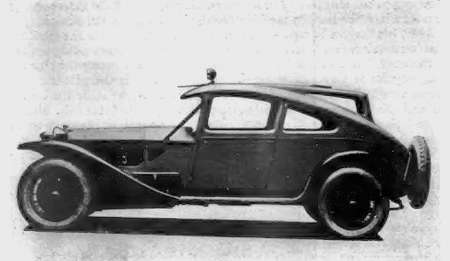
Lancia “Airway” Saloon
A customised car unveiled at the 1927 Olympia Motor Show at Olympia in the aftermath of Charles Lindbergh’s historic flight across the Atlantic.
The Lancia “Airway” Saloon – an exotic but practical design by a famous architect, Mr. Joseph Emberton, who designed the Advertising Exhibition at Olympia. It has distinctly super-sports lines, very low and racy, offering a minimum of head resistance. The standard fittings include a wireless receiving set, luncheon outfit —each concealed in the interior in polished walnut cabinets—a searchlight mounted on the roof and controlled from the driver's seat, an air-speed indicator, compass, altimeter, gradient meter, and an electric fan. The portion of the roof over the rear seat is raised somewhat to allow of head room for an occasional passenger, and in this raised roof is a fixed window on each side and one in the rear, while on the roof is mounted a large ventilator. The car finished in a very original colour scheme, the under-chassis and under side of the wings, bonnet, and doors being in bright red, while the tops of the toolboxes mounted on them, and the rest of the body is of cream colour. [The Bystander 19 October 1927 page iv]
SPORTS SALOON FOR A MOTOR CAR - Designed by Joseph Emberton, the problem was to provide complete comfort for three people and space for a reasonable amount of luggage in an enclosed sports car. The task was to create a shape which would offer the very minimum of air-resistance. and Mr. Emberton constituted something hitherto unknown realized in the way of stream-lining. [The American Architect page 354]
Emberton, Lancia, the Curtis Automobile Company (the British Lancia distributors) and the Albany Carriage Company came together in 1927, when Curtis commissioned Emberton to design a body on the corta or short chassis Lancia Lambda (Tipo 219). Whether specified by Curtis or emerging from his own flamboyant sense of design, Emberton’s pioneering attempt at streamlining was doubtless influenced by the universal fascination with aircraft and air travel at the time. Built by the Albany Carriage Co, the Airway saloon featured a steeply-raked windscreen and severely sloping roof-line. So restricted was rear seat head-room that the sole rear passenger enjoyed his own glazed cockpit – described in publicity material as the ‘conning tower’
Reputedly similar to those in the contemporary Vickers Vimy aircraft operated by Imperial Airways, the seats were constructed of wicker and were fitted with large pneumatic cushions trimmed in red antique leather, matching the red fitted carpets. Instrumentation supplied with the car bizarrely comprised items of more use in an aeroplane than a car. They included an air-speed indicator, an altimeter, a gradient meter and a compass ‘mounted on polished walnut blocks’. A swivelling searchlight was mounted on the roof, its motion controlled by levers placed to the driver’s right. The ‘conning tower’ also had its own glazed roof hatch with a retractable blind. The sole rear passenger also enjoyed a fan heater, , a picnic case cum liquor cabinet supplied by Messrs J B Brooks & Co; a radio in a polished walnut cabinet from the Halcyon Wireless Supply Company; and a Kodak 1A ‘Autographic’ camera.
The colour scheme selected by Emberton were suitably offbeat. “Fire Red” and “Ivory” were the favoured colours, red being applied to the chassis, to both doors, to both upper rear quarters and the luggage locker, bonnet, brake drums, wheel centres and the undersides of the wings. The remainder of the bodywork was finished in ivory, including the top surfaces of the wings, the battery boxes and the radiator surround.
The Curtis Company offered complete cars for £945 (although the wireless and picnic set were quoted as extras). It would seem that at least two cars were produced to Emberton’s original design, one of which was exported to Australia.
Thus ended Joseph Emberton’s automotive designing career, with one exception. In 1939 he designed the cars for the ‘Wild Mouse’ entertainment ride at the Blackpool Pleasure Beach,