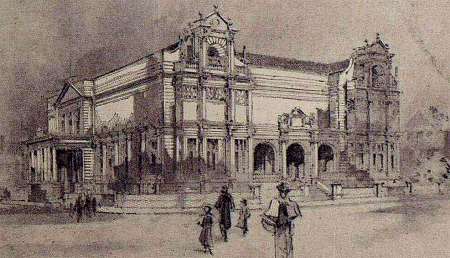
Bury Art Gallery and Library, Silver Street and Moss Lane, Bury
The Library and Art Gallery were built as a condition of the gift of the Wrigley collection of paintings to the local authority. James Wrigley and Son were paper makers of Bury, Manchester, and London. The foundation stone was laid by Oswald Wrigley on 29 April 1899 and the building was opened on 19 October 1901 by the Earl of Derby. The friezes by J. J. Millson are of classical figures. In the centre of the left panel is the muse Mnemosyne, flanked by Grammar (with vowels), Astronomy (the youthful figure holding celestial globe), and Rhetoric, holding the scroll. Street names are those at the time of construction. Silver Street previously Manchester Road. Moss Lane later Moss Street. See separate entry for architectural competition of 1897
The contract for the erection of the art gallery and public library at Bury Lancashire has been let to Messrs Thompson and Brierley, builders and contractors, Bury, the contract price being £21,259. [Building News 1 July 1898 Page 33]
THE WRIGLEY ART GALLERY AND PUBLIC LIBRARY, BURY - The foundation-stone of what will be handsome block of buildings to be devoted to the purposes of an art gallery and public library, and which are to be presented to the town of Bury by Mr. O. O. Wrigley, of Bridge Hall, will be laid to-day. The style of architecture adopted for the new buddings will be English Renaissance of the 18th century, freely treated. When finished the structure will comprise three complete storeys, consisting of basement floor, ground and first floors, with sub-basement for mechanical heating and ventilating under the portion at the rear. The first floor is to be entirely devoted the art galleries and will be entered by the main staircase through the sculpture hall from Moss Lane, and is arranged in sequence of five handsome rooms, with ample wall space for picture-hanging. A room for the curator and other necessary accommodation the rear of the building are all provided on this floor in connection with the art gallery. The ground floor will be used chiefly for library purposes and will be entered from Silver-street by a spacious vestibule twelve feet wide placed in the centre of the building. The vestibule will directly open into the borrowers' space, which will be about 40 feet wide. On the righthand side of the borrowers' space swing doors will give direct access to the magazine and news room, and on the left to the reference-room. A ladies' reading room will be provided and will be also accessible from the borrowers' space. portion of this floor will be occupied sculpture hall. The basement floor will be chiefly devoted to stores, but it is so planned that a portion could be easily converted into boys' reading room, and approached directly from the main staircase in Moss Lane, should it be thought necessary in the future to do so. Fire-resisting materials will be used in the building throughout, the floors generally being constructed of steel and concrete, and finished with wood blocks, tiles, etc.; the ceilings are being prepared with patent steel laths. The building will be heated and ventilated mechanically means of the " Plenum" system, aided by natural ventilation. The building will be of Derbyshire stone and Ruabon bricks. The contract for the work being carried out by Messrs. Thompson and Brierley, Bury, at cost of £21,259. The architects aro Messrs. Woodhouse and Willoughby, of 100, King Street, Manchester, whose plans were accepted out of 22 designs submitted in an open competition. The memorial-stone will be laid by Mr. Wrigley, who previous to the ceremony will be presented with the freedom of borough of Bury. [Manchester Evening News Saturday 29 April 1899 page 5]
BURY ART GALLERY AND PUBLIC LIBRARY - This building is situated at the corner of Moss Lane and Silver Street and has a frontage to Moss Lane of 110 feet and to Silver Street of 105 feet. The structure comprises three complete storeys —basement, ground, and first floors— with a sub-basement under the rear for the heating and ventilating plant. The first floor is entirely devoted to art and is entered from a sculpture hall on the ground floor by a spacious stone staircase. There are five galleries arranged in sequence, the sizes varying from 27 ft. by 33 ft. to 27 ft. by 61 ft. Provision is made for ladies' and gentlemen's cloak- rooms, lavatories, etc., and at the back of the building there are rooms for repairing, etc. A large hoist connects the loading way with all the floors. The ground floor has been devoted to library purposes, and will be entered by a vestibule, 12 feet wide. This vestibule opens direct into the borrowers' space, which is 40 feet wide. To the right of the borrowers' space swing doors open into the ladies' and reference rooms, and to the left admission to the magazine and reading rooms is gained in a similar manner. Separate conveniences are provided on each side of the entrance and are entered from the borrowers' space through ante-rooms. A librarian's room and a large bookstore are arranged in conjunction with the borrowers' space. The basement is chiefly devoted to stores under the library and connected therewith by a spiral staircase is a large book store. At the rear of the building a loading way for receiving books, pictures, etc, hoist, and packing-room are provided on this floor. The remainder is occupied by store- rooms for packing-cases, etc.
The main elevations are faced with boasted ashlar obtained from the Higher Stancliffe Quarries, Darley Dale, Derbyshire, the remaining elevations being faced with Edwards' Ruabon best selected red bricks. The joiner's work generally is Kauri pine stained. The gallery floors are laid with oak parquetry, the library with oak blocks, and the reading-rooms with pitch-pine blocks. The vestibules and halls have mosaic floors, and the steps, landings, etc., for the staircases are blue Shepley with Bath stone balusters and handrail. The building is heated and ventilated on the "Plenum" system, is of fireproof construction throughout, and is lighted by electricity. Messrs. Thompson & Brierley, of Bury, have carried out the general contract, their tender being £21,259. The clerk of works was Mr. G. E. Smirk, of Bury. The following special tradesmen have also been employed on the work: Messrs. Sutcliffe & Company, Manchester—heating and ventilating; The Banks Fireproof Construction Syndicate, London—fireproof construction; Mr. J. F. Ebner, London—art gallery floors; Messrs. C. W. Williams & Co., Manchester— mosaic; Mr J. J. Millson, Manchester—carving and sculpture work; Messrs. W. J. Pearce & Co., Manchester—leaded lights; Messrs. Heywood & Co., Huddersfield, —patent glazing; Messrs. Marley Bros., Birmingham—fire extinguishing apparatus; Messrs. Hardman, Powell, & Co., Birmingham—wrought-iron gates; Mr Burgoine, Bury—hoist; Mr. George Wragge, Salford—protection rails, brackets, etc.; and Messrs. Singer & Co., Frome— electric light fittings. The furniture and fittings have been executed in Dantzic oak by Messrs. Goodall, Lamb, & Heighway, Manchester, and the building has been painted and decorated by Mr. George Smith, of Bury. The whole of the work, including the fittings, has been designed and supervised by the architects, Messrs. Woodhouse & Willoughby, of Manchester. [Builder 12 October 1901 page 316-317 plans page 316 and illustrations]
Reference Building News 3 December 1897 - scheme illustrated
Reference Building News 1 July 1898 Page 33 – contract awarded.
Reference Building News 1 July 1898 Page xvi (Tenders)
Reference Manchester Weekly Times Friday 28 April 1899 page 2 with illustration
Reference Manchester Evening News Saturday 29 April 1899 page 5
Reference Manchester Guardian 1 May 1899 Page 10
Reference Manchester City News 6 May 1899 Page 3 - foundation stone
Reference Builder 6 May 1899 Page 451
Reference Illustrated London News Saturday 20 May 1899 page 17 - illustration
Reference Building News 6 September 1901 Page 314 - stone
Reference Builder 12 October 1901 Page 316-317. Plan page 316 and two-page illustration
Reference Manchester Guardian Thursday 10 October 1901 Page 9
Reference British Architect 18 October 1901 Page 285 with notes
Reference Manchester Courier Thursday 8 October 1901 page 6
Reference Public Monument and Sculpture Association National Recording Project