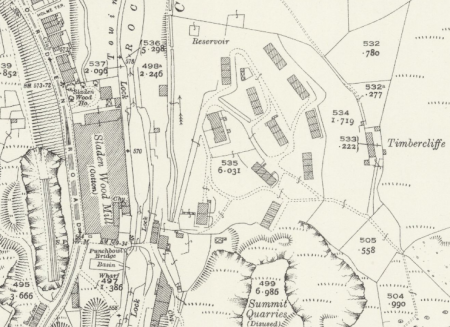
Concrete Houses, Timbercliffe, Littleborough
In 1913 Butterworth and Duncan, architects, Rochdale. were awarded first premium in a competition for the laying out of a Garden Suburb and were instructed to prepare plans of the houses. It is probable that the outbreak of war delayed progress and it was not until 1920 that work began on the construction of the first block of four dwellings. By February 1925 six blocks had been completed with another under construction. Two further blocks had been added by 1929. The submission of plans at various intervals indicate that design work was still in progress between 1920 and 1925. Although no architect for work in the inter-war period has been found, it is presently assumed that Butterworth and Duncan (II) were responsible.
CONCRETE HOUSES. A SUCCESSFUL EXPERIMENT AT LITTLEBOROUGH – In view of the discussion at the last meeting of Rochdale Town Council and the feeling then expressed that consideration should be given to alternative types construction in order to provide houses more quickly a particular interest attaches to the concrete houses built by Messrs Fothergill and Harvey Limited at Timbercliffe between Littleborough and Summit The first of houses were built the initiative late Mr Gordon Harvey five years ago and the scheme has been since carried on by his brother, Mr E. C. Harvey J.P. By this time therefore a fairly exhaustive trial has been given to this type of construction and the fact that this experience has resulted in the building of more concrete houses is evidence that they have proved satisfactory The sixth block of four houses is seen in the top photograph in the course of construction while plans for a seventh are now being prepared. The lower photographs shows a completed block which is now occupied
The concrete blocks of which the houses are built are made on the spot from clinker from the firm’s Sladen Mill. The clinker is crushed and mixed with cement in the proportion of six to one This is put into a mould to a thickness of 4 inches and a facing 3/8 inch thick composed two parts Shap granite one part cement is imposed upon it the whole being then damped by hand. These blocks, 18in by 9in are used for the outside walls with inner unfaced blocks, the thickness of the walls being twelve inches with a cavity of 3.5 inches. Past experience proved that the ordinary black mortar is not satisfactory and cement mortar is now used the result that walls form practically a solid mass of concrete which has proved extremely durable, free from cracks and weatherproof.
The Timbercliffe site has been a difficult one to lay out owing to its steeply rising gradient The first two blocks of houses were arranged fiats the flat on the upper storey being reached by steps from' the back Each flat is perfectly self-contained, the smaller type consisting of two bedrooms, living-room, parlour scullery bathroom and water closet while the larger type have three bedrooms. The later blocks are ordinary two-storeyed houses chiefly of the parlour type, with three bedrooms while one block consists of the living-room type with two bedrooms. The dimensions 'of the in the parlour type are: Parlour, 12 feet 6 inches by 10 feet; living room 13 feet 9 inches by 12 feet 6 inches; Scullery 10 feet by 6 feet 4 inches; Bedrooms, 12 feet by 12 feet, 9 feet 6 inches by 11 feet 9 inches, and 9 feet by 11 feet 9 in. The height the rooms is 8 feet 6 Inches. In view of the doubts which have been expressed in Rochdale as to the suitability of concrete construction for our rigorous climate an “Observer” representative visited Timbercliffe a few days ago enquired from several of the tenants on this point and they all agreed that the houses were absolutely dry and weatherproof. Working with such large-surfaced blocks the actual construction the shell can be done very rapidly, The block of houses shown above were only started from the floor line on December 7th and are now ready for roofing; practically all the concrete has also made during this period.
The irregularity of the site and the necessity of making roads, sewers, etc made the initial cost considerable but it is estimated that the actual cost of the four houses now in construction will be slightly over £500 gross from this the Government subsidy is deductible. As preference in tenancy is given to the employees of the firm an economic rent is not charged. To do would create an anomaly as between these houses and others built by the firm at Dean Head and elsewhere before the war Messrs Fothergill and Harvey Limited have over 100 houses in the district. [The Rochdale Observer Saturday 21 February 1925 page 14]
Reference The Rochdale Observer Saturday 21 February 1925 page 14 with photographs