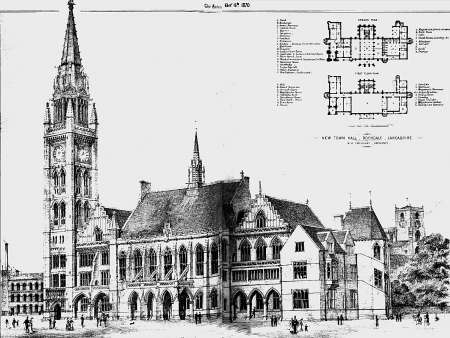
Rochdale Town Hall The Esplanade Rochdale
In 1864, Rochdale Council decided to allocate the sum of £20,000 to provide a suitable civic building. An architectural competition was duly held, won by W.H. Crossland of Leeds. From the time of Crossland’s appointment, civic pride knew no bounds. Reluctantly at first, but with increasing enthusiasm, the council approved alterations to the scheme. Costs soared from the original £20,000 to £155,000.
Designed in the Gothic style, the building was one of the finest municipal buildings in the region, the spire 240 feet high topped by a gilded statue of St George. The foundation stone laid by Rt Hon. John Bright MP on 31 March 1866 and the Town Hall was opened by the mayor, G.L. Ashworth, on 27 September 1871. Twelve years later, the spire was found to be riddled with dry rot and was due to be dismantled, but for reasons which are still unexplained the original wooden structure was destroyed by fire in 1883, the spire being so badly damaged that demolition was required. It was replaced by 1887 to a design by Alfred Waterhouse - tower fifty feet shorter than the original.
The ground floor entrance hall was originally intended as a woollen exchange but it was never used for this purpose.
TOWN HALL ROCHDALE - This important building, of which we gave an Illustration in THE ARCHITECT of October 15, 1870, and which been for some years in course of erection, has just been opened with the usual festivities and feasting. With its external features our readers are familiar; internally, it is more remarkable from its decorative than its architectural merit, and from the former point of view is worthy Of the highest praise. We know no building which has been so thoroughly decorated as has this, and Messrs. Heaton, Butler & Bayne, of London, and Mr. Best, of Rochdale, by whom these works have been executed, deserve the highest commendation for the careful manner in which they have carried out their respective portions.
Our hurried examination prevents us this week detailing more fully the result of their labours, but on some future occasion we hope more critically to enter into a review of the building and its accessories. The large hall has its open-timbered roof, richly coloured and gilt, the plastered spaces intervening between the timbers being decorated with the badges and armorial insignia of England, Scotland, and Ireland; the walls are covered with an undulating pattern of very rich ornament, the prevailing colours of which are grey, white, and chocolate. This portion seems to us to need horizontal bands of strong colour or gilding, and at present is too like a vast expanse of crétonne or cotton print to be quite satisfactory. At the end facing the dais is a somewhat weak painting of King John signing the Magna Charta, which, from the absence of any broad demarking boundary line, suffers greatly from the assertiveness of the general wall decoration. Adjoining this is a well-drawn trophy of the armorial bearing of the Barons whose radical proclivities secured to Britons that much-talked-of but little-known document. The decoration of the Council Chamber has for its motif the various improvements which have taken place in the process of weaving and spinning cotton and wool, the two staple trades of the town, and the cotton-plant is most effectively introduced into the wall-diaper here. The smaller rooms which adjoin this are remarkably good in the balance of colour and formation of the ornaments, and the frieze of the entrance-hall is a marvellous bit of drawing.
One fault we must find, and that is, that whilst the building partakes of an Early Decorated character, much of the ornament is of a very much earlier class of design, being formed on the principle of Anglo-Saxon illumination rather than on the known system of 14th century mural painting. In the refreshment room too, there is great discord produced by placing highly finished easel paintings of game and fish treated in the most modern naturalistic manner, in panels surrounded by fruits and flowers of conventional character. Still, with all these blemishes, the work is highly successful and marks a very important step in architectural decoration; and we heartily congratulate Mr. W. H. Crossland, the architect, on having found such able assistants as those to whom the work has been entrusted. [The Architect 30 September 1871 page 169]
ROCHDALE TOWN-HALL - Some twelve months since Messrs. Heaton, Butler, and Bayne, of Garrick Street, received instructions from the Corporation of Rochdale, through their architect, Mr. Crossland, to fill the whole of the windows in the principal rooms with stained glass; and to decorate the great hall, council chamber, borough court, and magistrates' private rooms in the richest possible manner. We illustrated these works on October 15, 1870, and recently described their inauguration.
On the grand staircase are nine large windows with heraldic glass, containing the Royal arms with red and white rose tree entwined —the Borough arms and arms of the Duchy of Lancaster. These are treated in the richest colours. The remaining windows contain the arms of the surrounding corporate towns—square panels on plain quarry backgrounds. The great hall is decorated in gold and colour. In the roof panels are the arms, crests, and legends of England. Ireland, and Scotland repeated. The timbers are decorated with branches of the Red Rose of Lancaster. The livery colours of the Royal family painted on wall plate. There are in thig hall eleven transom windows, filled with full-sized figures of the Sovereigns of England, commencing from William I. and ending with William IV. The upper portions of the lights are filled with the armorial bearings of each Sovereign. The large rose windows at either end of the hall contain portraits of the Queen and late Prince Consort, surrounded in quatrefoils with badges of the different orders of knighthood, and figures representing Arts and Sciences. There is a large historical fresco by Mr. Henry Haliday—the signing Of the Magna Charta. In this hall, on the right side of painting, is a panel containing chestnut-tree bearing shields of the conservators of the Charta.
Borough Court - The three windows are filled with eminent jurists, legislators, and judges, the windows opposite being filled with grisaille glass and borough arms. The roof is decorated with arms of the duchy of Lancaster, borough of Rochdale, and rose-en-soleil of England. The timbers are coloured and gilt.
Magistrates' Room - On the ceiling are shown the arms of the Mayors of Rochdale, with foliage filling up blank spaces; also arms of the Duchy of Lancaster and Borough of Rochdale. The walls are hung with Spanish embossed leather and diapered with a rose pattern. The upper lights and the tracery are filled with grisaille glass, the square quarries illustrating Earth, Air, Fire, Water.
The ceiling panels of the Mayor's reception are on a turquoise blue ground, with gold swallows, butterflies, and clusters of stars painted on it. The beams are decorated where they join the walls with Æsop's fables on gold grounds. The frieze is decorated with branches of English forest trees, the walls are diapered with a pine pattern in green and gold (Flemish pattern). In the upper lights of windows are illustrated the principal English fruits. In the tracery are the subjects of Morning, Noon, Evening, and Night.
In the Mayor's parlour, on the ceiling, are branches of the golden apple foliage with Dragon of Hesperides guarding the same; also peacocks and birds in foliage. The timbers are decorated with vine foliage with storks entwined. The frieze consists of golden foliage magnolias, and eight panels of English songbirds; the walls are decorated with birds and flowers. The upper lights are filled with subjects illustrating the twelve months of the year. In the tracery—Spring, Summer, Autumn, and Winter.
The ceiling panels of the vestibule are filled with subjects illustrating the trades of Rochdale. The frieze suggests the source of clothing before the art of weaving was invented. There are four lights of ornamental quarry-glass, on which are panels with shields of England and Wales, Ireland and Scotland, hung from branches of foliage. In the tracery the crosses of St. George, St. Andrew, St. Patrick, and Badge of Wales.
The east staircase windows are filled with square quarries ornamented with fleece, and shuttle patterns. West staircase windows contain similar quarries with cotton pod and cotton leaf. In the Exchange are eleven windows filled with quarry-glass and heraldic bearings of the different countries that trade most with Rochdale, the tracery pieces being filled with drawings illustrating common articles of commerce. The tile flooring was executed by Minton, Hollins & Company, from a design supplied by Mr. C. Heaton. The whole of the work has been most carefully done and at a great cost, the General Purpose Committee having acted in a very liberal sprit throughout. Mr. C. Heaton personally superintended the whole of the work during its progress, under Mr. Crossland, the architect. [The Architect v.6 21 October 1871 page 203]