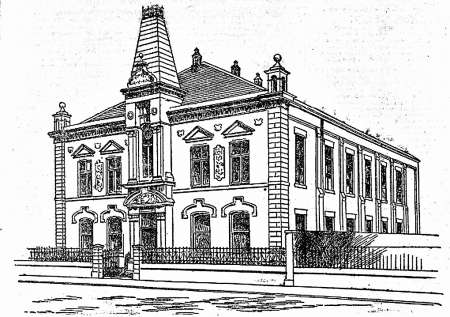
Textile Operatives' Hall, Manchester Road, Bury
Nineteenth century street name given as Manchester Road, running south from Moss Street. Now shown as Silver Street in front of Library and Textile Hall.
REARING DINNER - The rearing dinner in connection with the erection of the new Textile Operatives Hall in Manchester Road, Bury, took place on Saturday evening at the New Royal Hotel, Silver Street, Bury, when about 154 persons sat down to a capital repast. … those present included Mr. D. Hardman (architect of the building), Mr. James Thompson and Mr. J. H. Thompson (contractors), and Mr. James Mason (contractor for the lighting of the building). [Cotton Factory Times Friday 10 November 1893 page 8]
NOTE – The “Rearing Dinner” marked the completion of the roof timbers of the new building.
OPENING OF TEXTILE OPERATIVES’ HALL - The above illustration represents the new elegant structure which is to be opened to-morrow (Saturday) by Lady Dilke under the auspices of the Amalgamated Trades Council of Bury, and the Cardroom, Spinners, and Weavers' Associations. Last week we published a full programme of the arrangements in connection with the opening ceremony, and are now able by the courtesy of the architect, Mr. D. Hardman, Silver-street, Bury, to present our readers with a correct description of the handsome suite of buildings as follows The site of the new building is situate in Manchester-road, between St. Marie's Catholic Church and Moss-lane. The frontage to Manchester-road is 75 feet, and the area covered is about 904 square yards. The building proper is placed in the centre of the site, allowing a passage on each side of 7ft. 6in, wide for the purpose of light and for access to the private side entrances. The whole of the ground floor is arranged in suites of offices, divided by a long and spacious corridor with tiled floor, running the full depth of the building, from which a separate entrance is obtained to each room. The offices on the main front, four on the ground floor and one above, will be used by the secretaries of the three associations who have defrayed the cost of the new buildings, viz., the Cardroom, the Spinners, and the Weavers, whilst some of the remaining rooms will be eligible to be let to other trades unions and private individuals. At the front entrance is a commodious hall, with ornamental tiled pavement and panelled and enriched moulded ceiling, this hall being divided from the back corridor by ornamental partitioning glazed with polished plate glass. The whole of the walls and ceilings in corridor and hall are finished off in Robinson cement which gives a light and cheerful appearance to the whole. From the main entrance hall there are two broad open staircases leading up to the floor above, the steps of are formed of highly polished granite concrete, with moulded fronts and ends, and made off with ornamental iron balusters and mahogany polished handrailing, with two handsome newel posts at foot of steps. On the upper floor, and approached from a capacious landing, is a large meeting room and platform, capable of seating 1,000 persons. This room has a clear span of 55 feet, free from iron columns or other obstructions. The floor is fireproof and soundproof, formed with iron posts and concrete, and finished on top with finely wrought pitch pine boarding, a space being left between the boards and concrete so as to render the floor more pliable and comfortable, besides being more suitable for dancing purposes. The ceiling is formed with plaster, in ornamental moulded panels, with circular cave on each side and along the platform, the whole being of a very elaborate, but extremely light and elegant design. From the ceiling are suspended nine artistically wrought gas coronas in black and copper relief for lighting the large hall on the most improved principle. The whole of the building throughout has also been wired for electric lighting. In arranging the plans, the architect, Mr. D. Hardman, of Silver-street, Bury, has kept in view the extreme importance of having good access and egress to and from the large meeting room without any undue crowding, and instead of there being only one main doorway into the room, as is very often the case, there are two spacious main openings with swing doors, so that there will be two streams of persons passing out of the room at the main entrances, each stream going down separate open staircases from each side of a spacious landing, and merging in the open hall at the front entrance to Manchester Road. In addition to the above, there are two wide staircases at the platform end of the room, and having their exit at the side doors, and the matter of emptying the room need occupy only a very few minutes. There are also separate staircases for speakers, entertainers, and others, with ante-rooms, etc., from the platform. On this upper floor also and occupying nearly the fall length of the frontage to Manchester Road, there is a council room, capable of seating 150 persons. This room is also suitable for small parties, etc. There is also ample lavatory accommodation, cloakrooms, store-rooms, etc., throughout. The whole of the building is exceedingly well lighted and ventilated and is heated throughout on the low pressure hot-water system, the boiler, etc., for which is placed in the roomy cellaring at the rear of the building. The copper boiler and tea-brewing apparatus are also placed in the cellar, from which there will be a hoist direct to the large hall above. The exterior of the building fronting Manchester Road has a very handsome and striking appearance. It is built of the best Yorkshire stone, from the Cullingworth Quarries, well relieved with bold mouldings, cornices, and projections. In the centre of the front there is a projecting tower, at the bottom of which is a noble entrance doorway with carved pilasters and panels. The upper portion of the tower has polished red granite pilasters with carved stone caps and bases, and over these a moulded projecting cornice, with bold moulded brackets under same, and large moulded stone on top carved in raised capitals "Textile Operatives' Hall, 1893." The whole is surmounted by a high slated roof, with ornamented iron railing and flagstaff on top. A noteworthy feature on the front elevation is the stone carving in the panels. These represent the three associations concerned, the carved illustrations showing the different branches of the textile industry, both with figures and machinery, which are very effective. The remaining elevations are faced with the best machine dressed stock bricks copiously relieved with stone dressings and with projecting buttresses on the two sides. The whole of the works have been carried out from designs and under the personal supervision of Mr. David Hardman, architect, Silver-street, Bury, all of which have been executed in a most satisfactory manner by Messrs. Thompson and Brierley, of Bury, the sole contractors; and the following is a list of sub-contractors:— Mr. James Mason, of Bury, plumbing end glazing; Messrs. John Murphy and Co., Bury, slating; Messrs. Evans and Sons, Whitefield, plastering and painting, and Mr. J. Rawson, Bury, tiling. The following have also carried out separate contracts, viz: Mr. Thos. Blomeley, Bury, heating apparatus; Mr. Samuel Gregson, Bury, ventilating; Messrs Whittick and Royle, Manchester, stone carving; Mr. Robert Howard, Tottington, ornamental gates and railing, and Mr. John Hindle, Bury, the preparations for electric lighting. The engraving given above is from a photograph by Mr. E. Eccles, Broad Street, Bury. The total cost of the building, including fittings, will be about £5,000. [Cotton Factory Times - Friday 4 May 1894 page 4]
The Textile Operatives' Hall, in Manchester Road, built at a cost of about £8,000 by local textile associations, viz.: the Bury, Radcliffe and District Weavers' and Winders' Association and the Bury and District Card, Blowing and Ring Spinners' Association, and opened by Lady Dilke, May 5th, 1894, is a two storey structure of brick and stone from designs by Mr. David Hardman, architect. The panels on the front elevation have carved illustrations of the different branches of the textile industry. [Kelly]
Above the porch of the central doorway is a semi-circular carved panel of two female figures representing Spinning (her right hand resting on a spinning wheel) and Weaving (holding a shuttle, a power loom at her feet). On the upper storey between the two windows either side of the central porch are carved panels depicting the textile trades. The left-hand side panel represents carding, a male operative standing in front of a carding engine. The right-hand side panel depicts two female operatives doffing bobbins on a roving frame. The panels were the work of the Manchester firm, Whittick and Royle. The building included meeting rooms as well as offices for trade union officials.
Reference Cotton Factory Times Friday 10 November 1893 page 8 - Rearing Dinner
Reference Cotton Factory Times - Friday 4 May 1894 page 4 - opening
Reference Kelly Directory 1902
Opened 5 May 1894 by Lady Dilke