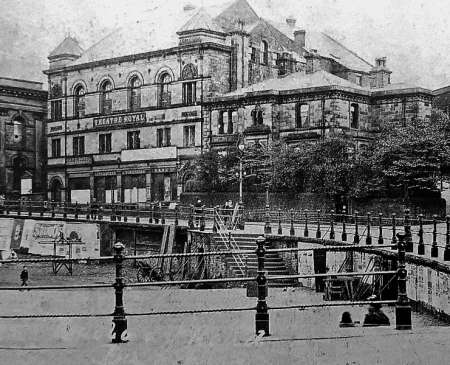
Theatre Royal Railway Road, Darwen
Built in the Italianate style at a cost of £10,000 the Theatre Royal, Church Street, Darwen, opened its doors on 12 March 1877. With a large stage, dress circle, gallery and seven dressing rooms the building also included four shops on the ground floor and offices on the first floor. However, the post office took over from those shops in 1890. It saw many name changes including the Hippodrome Cinema, the Darwen Picture Palace and others with a variety of owners and grand re-openings.
NEW TEMPERANCE HALL AND THEATRE - The above large and handsome structure is now rapidly approaching completion and will be thrown open to the public early next month. The building was originally designed on a small scale for a Temperance Hall and was projected by a Limited Liability Company formed for that purpose. After the work had been carried on a time It occurred to some of the shareholders that there was a need in Darwen of a respectable, properly finished and appointed, Theatre. A proposal to convert the building into a Theatre was submitted to a meeting of shareholders and was by them adopted and approved. The architect was accordingly instructed to enlarge and revise his plans; an additional plot of ground necessary for the enlargement was taken, and the work of alteration was proceeded with. The building occupies a good site in Railway Road, adjoining the Wesleyan Chapel, and may indisputably be considered as a valuable contribution towards the architectural improvement of that busy street. The style of architecture is Italian. Four handsome and convenient shops occupy the front of the ground floor, each having a good and well-lighted cellar for storage. A range of offices above the shops are approached by stone staircases, one at each side of the facade. These will be well adapted for the use of professional and commercial men. The main floor which extends over the whole of the site forms the floor of the theatre and the stage with its usual adjuncts. This is a finely proportioned and lofty room with a spacious gallery and will comfortably accommodate 1.800 persons. The stage itself is unusually large for a provincial theatre. It is now being fitted up with new and costly scenery by Mr Hawley from the Prince’s Theatre, Manchester. Rhere are also two lesser halls underneath which are well-adapted for public meetings and other uses. Committee, retiring, dressing and cloak rooms are placed conveniently at various parts of the building. The stage will be specially supplied with lengths of hose with hydrants and other apparatus for the immediate extinction of fire. The architect in planning the building has taken special care to supply ample and abundant means of exit in case of sudden alarm. These arrangements were considered very satisfactory by the Bench of magistrates when inspecting the theatre before granting a licence. The contract for the building was taken by Messrs Kay and Rucklidge, builders, Darwen and it has been satisfactorily caried out by them. The work, allowing for bad weather and other causes, has taken about eighteen months to complete. The total cost, including gas and water fittings, heating apparatus, theatre fittings and furniture, will be between £?,000 and £10,000. The auditorium of the Theatre is brilliantly lighted by two patent hydro-carbon gas lights supplied by Messrs Rigby and Son, Manchester. Mr Hayworth of Manchester supplied the stage gas fittings, The heating apparatus, Parkin’s Patent, is by Mr R. R. Gibbs of St James Street, Liverpool. The plumbing, glazing and gas and water fittings is by Mr Sutcliffe; the brickwork by Mr Walsh; and the plastering by Mr Jackson, all of Darwen. The two sculptural panels on the front are emblematical of Music and the Drama and were executed by Mr Thomas Allen, architectural sculptor, Blackburn. The architect was Mr E. Potts of Oldham under whom Mr E. Edwards has acted as clerk of the works. The theatre has been leased for a term of years by Mr Sidney, of Manchester and Leeds, and will, when completed, be opened by him with a first-class dramatic company. [Darwen News Saturday 13 January 1877 page 2]
Reference British Architect 26 January 1877 Page 58
Reference Darwen News Saturday 13 January 1877 page 2